The background to this initiative is very simple. It is to illustrate to the peoples of our world, the history of the civilisations of the Ummah.
“Because they don’t know our history, they don’t know our literature, they don’t know our philosophy, they don’t know the physical environment in which our countries have lived, they view the Ummah in terminology which is completely wrong.
“My interest in working in Syria is to take the various lead countries of the Ummah and say, let’s start, let’s move together, let’s revive our cultures so that modernity is not only seen in the terminology of the west, but in the intelligent use of our past,”
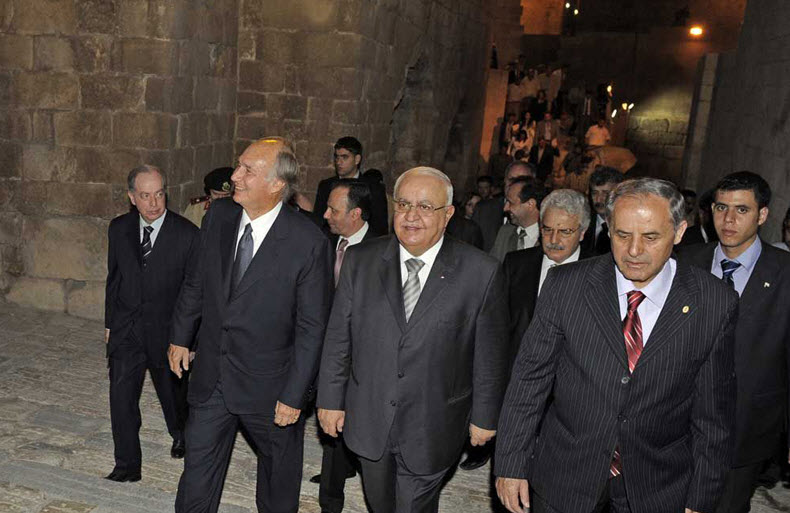
– His Highness Prince Karim Aga Khan at the inauguration ceremony of the restored Citadel of Aleppo, Aleppo, Syria, August 28, 2008 ***
Located at the crossroads of various trading routes since the second millennium BC, Aleppo, in Syria, is one of the world’s oldest continuously inhabited cites. The Citadel of Aleppo rises majestically above the ancient city and is one of the foremost monuments of the Islamic world. Although the Citadel is an Islamic landmark, archaeological digs have uncovered Roman and Byzantine ruins dating back to the 9th century BC and was originally built on a natural hill to provide a strategic site for a military fortress to guard and protect the surrounding agricultural areas.
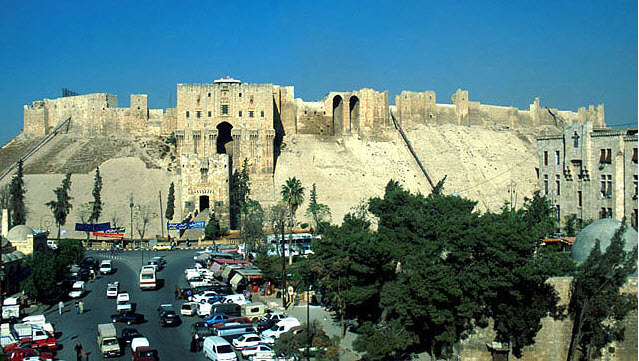
(Image: Archnet)
The Citadel underwent major reconstruction during the reign of the Ayyubid Sultan, al-Zahir al-Ghazi (r 1186-1216), to create the complex in its current form. A significant addition during al-Ghazi’s reign is the mosque that was built in 1214. During the Ottoman period (1299-1923), the military role of the Citadel as a defense fortress diminished as the city began to grow outside the city walls and became a commercial metropolis.
“The diverse mixture of buildings including the Great Mosque founded under the Umayyads and rebuilt in the 12th century; the 12th century Madrasa Halawiye, which incorporates remains of Aleppo’s Christian cathedral, together with other mosques and madrasas, suqs and khans represents an exceptional reflection of the social, cultural and economic aspects of what was once one of the richest cities of all humanity.”*
The Citadel was recognized as a World Heritage Site by UNESCO in 1986. In 2000, the Aga Khan Trust for Culture (AKTC), in partnership with the Syrian Directorate General of Antiquities and Museums, initiated a major restoration project for the Citadel. On August 28, 2008, during his Golden Jubilee visit to Syria, His Highness the Aga Khan and the Prime Minister of Syria attended a ceremony to mark the completion of the revitalization work on the citadels of Aleppo, Salah ad-Din and Masyaf.
In 2001, the awards for the Aga Khan Award for Architecture were presented at the CItadel of Aleppo. In his address, the Aga Khan reflected upon the diversity and pluralism that enabled the intellectual, commercial, and cultural development in Syria:
“Damascus and Aleppo are among the oldest continuously inhabited cities in the world. They functioned as major seats of commerce and learning for over 1000 years and as a central stage in the critical first century of Islam. Since that time, Syria has demonstrated the power of Islam as a crucible for the spirit and the intellect, transcending boundaries of geography and culture. It has demonstrated the Muslim eagerness to learn and adapt, and to share and bequeath an enhanced understanding of man and the universe. It is also a testimony to the Quranic ideal of a vibrant humanity, rich in pluralism, and yet constituting a single human community. This heritage of respect for difference is admirably sustained in Syria today in the value it attaches to diversity, pluralism and positive and productive relationships between different segments of society.”**
**Speech at http://www.akdn.org/Content/580
References:
* Ancient City of Aleppo, UNESCO
Aleppo, Syria, Archnet
Islam: Art and Architecture Edited by Edited by Markus Hattstein and Peter Delius. Cologne. Konemann. 2000
*** AKDN | His Highness the Aga Khan Visits Syria New Projects Launched
Research by Nimira Dewji
 Be the First to Know – Join Ismailimail
Get breaking news related to the Ismaili Imamat, the world wide Ismaili Muslim community and all their creativity, endeavors and successes.
Inspired? Share the story
Want to inspire? Send your stories to us at Ismailimail@gmail.com
Subscribe and join 21,000 + other individuals – Subscribe now!
Earlier & Related from the Ismailimail Archives
 Mawlana Hazar Imam was gifted manuscripts on architecture of Andalusia, a Knowledge Society of its time - The fundamental reason for the pre-eminence of Islamic civilisations lay neither in accidents of history…
 Mawlana Hazar Imam Designates Ismaili Center Houston as Darkhana for US Jamat, the ninth Darkhana - (the light is lit) in houses of worship which God has allowed to be raised,…
 Imam Hasan ala dhikrihi’l-salam appointed Sinan as his deputy in Syria - Rashid al-Din Sinan, the greatest of the medieval Nizari Ismaili da’is in Syria, was born into a…
 The arts of the Fatimids, Mawlana Hazar Imam’s ancestors, continue to inspire - The official logo for Hazar Imam’s visits comprises the word nur, Arabic for light, repeated…
 Rumi: “The light that lights the heart is the Light of God” - Didar – A Persian word meaning ‘seeing” or “vision.” The vision can be experienced both…
 Pir Sabzali: “Hearing the farman, their eyes brimmed over with tears of joy” - After the fall of the Nizari Ismaili state of Alamut to the Mongols in 1256,… Al-Tusi: “The ‘nass’ is not in order to make him an Imam; it is … so that people should recognise him as such” - “O Messenger, deliver [to the people] what has been revealed to you from your Lord,…
 Ismailimail
Great work is being done by AKTC under the able guidance of His Highness. Allah bless the efforts of AKTC.
LikeLike