The Aga Khan Foundation (AKF), alongside its sister Aga Khan Development Network (AKDN) agencies, has implemented innovative, award-winning and community-driven solutions to development challenges for more than 45 years.
It focusses on a small number of specific development problems by forming intellectual and financial partnerships with organisations sharing its objectives.
With a small staff, a host of cooperating agencies and thousands of volunteers, the Foundation reaches out to vulnerable populations on four continents, irrespective of their race, religion, political persuasion or gender.
The map below provides a snapshot of AKF’s current activities.
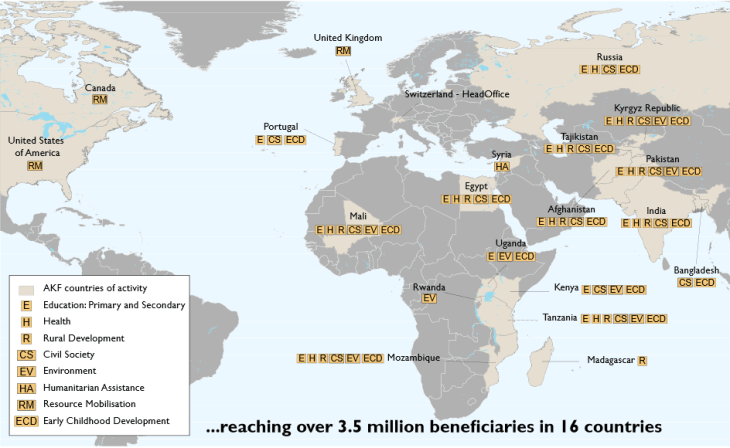
Discover, explore and Learn more via Overview of the Aga Khan Foundation
About Aga Khan Development Network (AKDN)
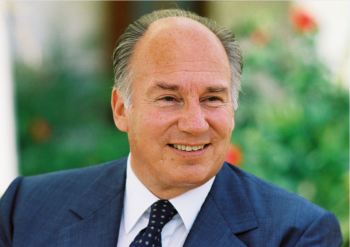 His Highness Prince Karim Aga Khan, the founder and chairman of the AKDN, is the 49th hereditary Imam (Spiritual Leader) of the Shia Ismaili Muslims and a direct descendant of the Prophet Muhammad (peace be upon him) through his cousin and son-in-law, Ali, the first Imam, and his wife Fatima, the Prophet’s daughter.
The Aga Khan has emphasised the view of Islam as a thinking, spiritual faith, one that teaches compassion and tolerance and that upholds the dignity of man, Allah’s noblest creation. In the Shia tradition of Islam, it is the mandate of the Imam of the time to safeguard the individual’s right to personal intellectual search and to give practical expression to the ethical vision of society that the Islamic message inspires.
In Islam’s ethical tradition, religious leaders not only interpret the faith but also have a responsibility to help improve the quality of life in their community and in the societies amongst which they live. For His Highness the Aga Khan, this has meant a deep engagement with development for over 55 years through the agencies of the AKDN.
AKDN is a contemporary endeavour of the Ismaili Imamat to realise the social conscience of Islam through institutional action. Its ten agencies address complex development issues, including the provision of quality healthcare and education services, cultural and economic revitalization, micro-enterprise, entrepreneurship and economic development, the advancement of civil society and the protection of the environment.
The agencies of the AKDN are private, international, non-denominational development organisations. AKDN brings together, under one coherent aegis, institutions and programs whose combined mandate is to help relieve society of ignorance, disease and deprivation, and in the process improve the welfare and prospects of people in the developing world, particularly in Asia and Africa, without regard to faith, origin or gender. The AKDN works in 30 countries around the world. It employs approximately 80,000 people, the majority of whom are based in developing countries. The AKDN’s annual budget for non-profit development activities is approximately US$ 600 million.
AKDN: An Ethical Framework
- Ethic of Inclusiveness
- Ethic of Education and Research
- Ethic of Compassion and Sharing
- Ethic of Self-Reliance
- Ethic of Respect for Life and Health Care
- Ethic of Sound Mind
- Ethic of Sustainable Environment: Physical, Social and Cultural
- Ethic of Governance
Learn more, read the ethical framework that informs the AKDN’s work.
 Be the First to Know – Join Ismailimail
Get breaking news related to the Ismaili Imamat, the world wide Ismaili Muslim community and all their creativity, endeavors and successes.
Inspired? Share the story
Want to inspire? Send us your story(s) at ismailimail@gmail.com
Subscribe and join 18,000 + other individuals – Subscribe now!
Recommended stories on Aga Khan IV :


Recommended stories on Aga Khan III:



 Ismailimail
Impressive
LikeLike