 There Is a Whole World Inside Every Plant
Plants have microbiomes, too, and they’re full of untapped secrets.
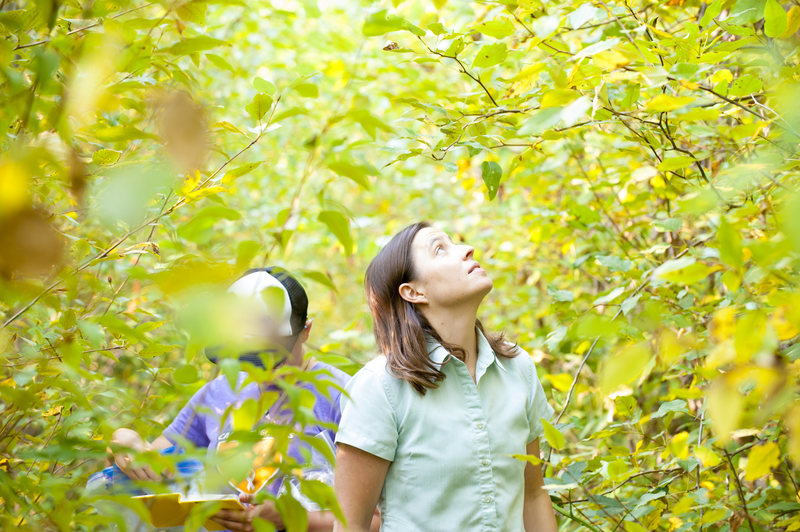
IN CORVALLIS, OREGON, POSY BUSBY works in a garden planted with 3,000 black cottonwood trees that represent 1,000 unique genetic specimens, each originally found somewhere on the West Coast of North America, from California to Canada. Cottonwoods are some of the fastest-growing trees in the world, and the garden looks a lot like a timber company plantation. But Busby, an ecologist at Oregon State University, studies something on a much smaller scale than trees—the microbes that live inside their leaves.
Busby started paying attention to microbes because she wanted to understand why wild plants plagued by a disease, such as leaf rust, fall ill in one place and not another. Genetics and environment could explain only part of this puzzle. But inside a plant is a whole world of microorganisms, and some of the cottonwoods’ resident microbes seemed to have an impact on the severity of the leaf rust.
At first Busby thought of these bacteria and fungi as individuals that could be either troublesome or beneficial to the plants, like the fungus that causes leaf rust. But as she read up on the human microbiome, she realized that the microbial communities within plants were as complex as those within us. “We’re really dealing with the same thing,” she says.
Read more at the source: Atlas Obscura / SARAH LASKOW / MAY 29, 2018

 Ismailimail
There is a reason why GOD made nature, animals, etc… for us to enjoy and nourish his creation, but few really understand this and mankind is destroying all these things that are necessary for us, hence the Aga Khan always has gardens wherever he builds necessary buildings, which are unique for all to enjoy and hope mankind will stop destroying the creation of GOD.
LikeLike
I love this article: it helps me to understand how some members of plant and human microbiomes become so essential to the overall organism’s success that these bacteria in a win-win case sacrifice themselves and lose their own identity and unique nature to become very important organelles within the cells in which they live, carrying out life-preserving and life-enhancing functions: in plants I am talking about the chloroplast, which relinquished its individual existence as a bacterium to evolve into a an organelle capable of capturing ultraviolet light from the sun, mixing it up with water within the plant and carbon dioxide from the atmosphere to convert radiant solar energy into high-energy molecules which can catalyze the reaction making new food for plants and mammals, ie, carbohydrate(glucose) for the plant’s nutrition and oxygen released back into the atmosphere for mammalian species(such as humans and animals) to breathe in.
In mammals(such as humans and animals) I am referring to the organelle called a mitochondrion, which evolved from its individual and separate existence as a bacterium to become the power plant of the cell, using carbohydrate(glucose) and oxygen made by the mammalian species to create energy molecules usable by the mammalian cell for its essential existential needs.
The mutual symbiosis described by these two situations above occurs ubiquitously in Nature, for example, specialized rhizobial bacteria living on and within the roots of a plant underground capturing nitrogen from the soil to help the plant to make proteins both as building blocks for the structure of the plant’s body and also as a good source of edible protein for mammalian nutrition, for example, a high protein food such as quinoa, legumes, spinach, etc:
Finally for understanding the above processes within the context of God’s Magnificent Creation and religious Theology and Philosophy we have these utterances to fall back upon:
“……The Quran tells us that signs of Allah’s Sovereignty are found in the contemplation of His Creation – in the heavens and the earth, the night and the day, the clouds and the seas, the winds and the waters….”(Aga Khan IV, Kampala, Uganda, August 22 2007)
“….in Islam, but particularly Shia Islam, the role of the intellect is part of faith. That intellect is what seperates man from the rest of the physical world in which he lives…..This notion of the capacity of the human intellect to understand and to admire the creation of Allah will bring you happiness in your everyday lives. Of that I am certain”(Aga Khan IV, Dar-es-Salaam, Tanzania, August 17th 2007)
“In fact this world is a book in which you see inscribed the writings of God the Almighty”(Nasir Khusraw, 11th century Fatimid Ismaili cosmologist-philosopher-poet)
“O brother! You asked: What is the [meaning of] `alam [world] and what is that entity to which this name applies? How should we describe the world in its entirety? And how many worlds are there? Explain so that we may recognize. Know, O brother, that the name `alam is derived from [the word] `ilm(knowledge), because the traces of knowledge are evident in [all] parts of the physical world. Thus, we say that the very constitution (nihad) of the world is based on a profound wisdom”(Nasir Khusraw, 11th century Fatimid Ismaili cosmologist-philosopher-poet, from his book “Knowledge and Liberation”)
http://gonashgo.blogspot.com/2008/09/400blogpost-four-hundred-knowledge.html?m=1
LikeLiked by 1 person