Newly found galaxy cluster could become most massive structure in universe
‘We’ve never observed a cluster like this before,’ Canadian astronomer says
Source: CBC News Technology & Science / Nicole Mortillaro / April 25, 2018
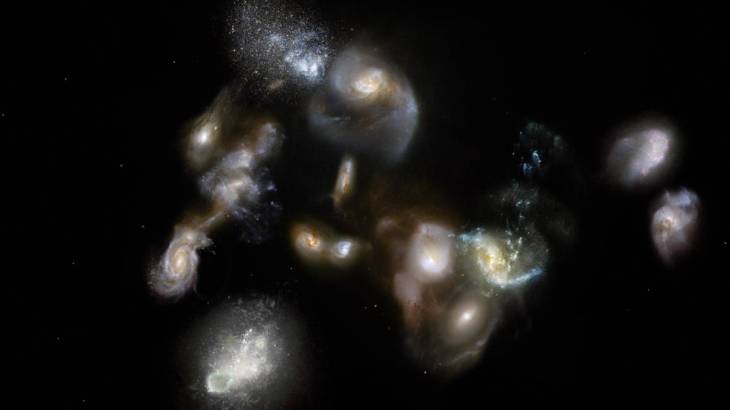
About 12.4 billion light-years from Earth lies a collection of galaxies that could end up as the most massive structure in the universe.
An international group of astronomers, including researchers from Dalhousie University and the University of Victoria, found the cluster using the South Pole Telescope in Antarctica. The telescope doesn’t observe in optical light but rather in short wavelengths called submillimetre and millimetre. This allows it to peer into dark clouds and delve deeper into star formation and into the earliest time in our universe.
The team found a particularly bright source and followed up using telescopes in Chile. Their observations revealed that one source, dubbed SPT2349-56, is giving birth to galaxies — 14 that they observed — at an astonishing rate.
“In the Milky Way, the star formation rate is like two or three [solar masses a year] ,” lead author of the paper published Wednesday in the journal Nature, Tim Miller, told CBC News. “But the star formation rate that we see, in this galaxy, ranges from about 50 to 1,000 times that of the Milky Way. They’re forming at a spectacular rate.”
Source: CBC News Technology & Science / Nicole Mortillaro / April 25, 2018
What’s mind-blowing, the researchers say, is how massive the structure already is at such an incredibly young point in the universe’s evolution. Something of this nature wasn’t expected to have formed until about three billion years after the Big Bang. But this structure — that is still in the process of forming — is seen just 1.4 billion years after the Big Bang. Something that will become much larger isn’t expected until at least 10 billion years.
Galactic dinner party
Our universe is full of clusters and superclusters of galaxies that can contain anywhere from hundreds to thousands of these galaxies. Our own Milky Way belongs to the Virgo supercluster, potentially home to more than 2,000 galaxies.
Astronomers believe that when these clusters form, at their centre lies a “gargantuan” galaxy that snacks on surrounding galaxies, growing in mass.
“They cannibalize these satellite galaxies around them and grow in dribs and drabs, so we don’t really expect them to turn into massive systems until relatively recently,” Arif Babul, co-author of the study and a professor at the University of Victoria, told CBC News. “Here you have 14 galaxies smashing together and forming something that resembles one of our gigantic galaxies in the universe. That’s unusual. In a way, that’s kind of mind-blowing.”

Source: CBC News Technology & Science / Nicole Mortillaro / April 25, 2018
Babul said that while 14 galaxies are what they see in a very small region, there are additional galaxies spread around it, perhaps 50 or 60. And if you reach farther out, there could potentially be several hundreds or even thousands. While they won’t necessarily become part of the core galaxy, they will eventually become part of the larger structure.
Over billions of years, the galaxy will become so big from swallowing everything in its nearby neighbourhood that only rarely will other galaxies wander in. It’s like someone eating at a dinner table, Babul said, and running out of food.
“We’ve never observed a cluster like this before,” said Miller, a Dalhousie University graduate student now at Yale University.
Source: CBC News Technology & Science / Nicole Mortillaro / April 25, 2018
Rethinking clusters
This new cluster, or protocluster, contains a mass that is almost 10 trillion times that of our sun.
A model from the researchers suggest the newly discovered 14 galaxies will become one giant elliptical galaxy — one of the most common in the universe — with a halo of galaxies, dust and stars. It will then grow, achieving a mass 1,000 trillion times that of our sun, similar to one of the most well-studied clusters we know, the Coma cluster.
The Coma cluster is one of the richest known, lying 320 million light years away, and could span 20 million light years.
You can see just some of the rich galaxies in the European Space Agency video below. Aside from a handful of stars, everything you see is a galaxy.
The discovery of this early forming cluster may just be an outlier, or it could indicate that the theory on cluster evolution has to be re-examined.
“But one of the joys of science is to find chinks in the armour, and it’s the chinks that lead you to interesting discoveries,” Babul said. “That’s where exciting discoveries lie.”
Source: CBC News Technology & Science / Nicole Mortillaro / April 25, 2018

 Ismailimail
This is a remarkable discovery of new knowledge! Sweeter still is that one of our very own bright stars on two counts, our fellow Canadian and fellow co-religionist Astrophysicist Professor Arif Babul from the University of Victoria in British Columbia played a big part in this discovery. It’s always something to celebrate and rejoice over when something new is uncovered in Allah’s Magnificent Creation. It is precisely akin to a new verse or ayat of scriptural revelation being unveiled:
“Islam is a natural religion and the God of the Quran is the One whose Ayats(Signs) are the Universe in which we live, move and have our being”(Aga Khan III, April 4th 1952, Karachi, Pakistan);
Imageary, figures of speech, metaphors and symbolism depicting knowledge, intellect, learning, reading, writing, education and teaching abound ubiquitously in the Noble Quran and in the utterances of “those well-grounded in knowledge”:
“Nature is the great daily book of God whose secrets must be found and used for the well-being of humanity”(Aga Khan III, Radio Pakistan, Karachi, Pakistan, February 19th 1950);
“In fact this world is a book in which you see inscribed the writings of God the Almighty”(Nasir Khusraw, 11th century Fatimid Ismaili cosmologist-philosopher-poet);
In a teaching session Ismaili cosmologist Nasir Khusraw opined:
“O brother! You asked: What is the [meaning of] `alam [world] and what is that entity to which this name applies? How should we describe the world in its entirety? Explain so that we may recognize;
Know, O brother, that the name `alam is derived from [the word] `ilm(knowledge), because the traces of knowledge are evident in [all] parts of the physical world. Thus, we say that the very constitution (nihad) of the world is based on a profound wisdom”(Nasir Khusraw, 11th century Fatimid Ismaili cosmologist-philosopher-poet, from his book “Knowledge and Liberation”);
Likewise, Sunni theologian-philosopher-mystic Abu Hamid Al-Ghazali reveals a key distinction:
“The physician considers [the bones] so that he may know a way of healing by setting them, but those with insight consider them so that through them they may draw conclusions about the majesty of Him who created and shaped [the bones]. What a difference between the two who consider!”(Abu Hamid Al-Ghazali, Muslim Theologian-Philosopher-Mystic, d1111CE);
Lastly the Prophet of Islam succinctly points out the intrinsic value and worth such a discovery made by Professor Babul and his team really indicates:
“One hour of contemplation on the works of the Creator is better than a thousand hours of prayer”(Prophet Muhammad, circa 632CE);
“The ink of the scholar is better than the blood of the martyr”(Prophet Muhammad, circa 632CE).
As we come full circle from the 7th century to embrace the 21st century those who are considered to be “well-grounded in knowledge” have the final say on this subject:
“The Qur’an itself repeatedly recommends Muslims to become better educated in order better to understand God’s creation”(Closing Address by His Highness Aga Khan IV at the “Musée-Musées” Round Table Louvre Museum, Paris, France, October 17th 2007);
“……The Quran tells us that signs of Allah’s Sovereignty are found in the contemplation of His Creation – in the heavens and the earth, the night and the day, the clouds and the seas, the winds and the waters….”(Aga Khan IV, Kampala, Uganda, August 22 2007).
LikeLike