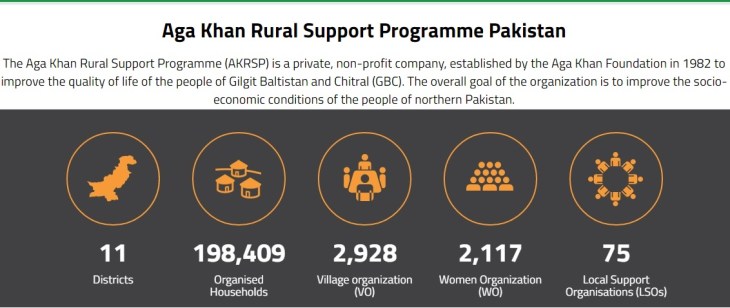
The Aga Khan Rural Support Programme (AKRSP) is a private, non-profit company, established by the Aga Khan Foundation in 1982 to improve the quality of life of the people of Gilgit Baltistan and Chitral (GBC). The overall goal of the organization is to improve the socio-economic conditions of the people of northern Pakistan.

AKRSP has built a strong foundation of people’s institutions, comprising more than 3700 Village and Women Organizations, majority of whom have come together to establish more than 70 Local Support Organizations (LSOs) as their representative institutions. These LSOs take on a multi-sector agenda in partnership with a wide array of partners including the local government departments. LSOs are increasingly taking on a development agenda that goes beyond the traditional approach.
AKRSP’s development approach gives primacy to the people and their abilities. It is based on the belief that local communities have tremendous potential to plan and manage their own development, once they are organized and provided access to necessary skills and capital. AKRSP’s past efforts have led to many notable achievements in social and economic domains.
Achievements:
Key achievements include:
- manifold increase in incomes,
- construction/rehabilitation of more than 4000 small infrastructure projects (bridges, roads, irrigation channels, hydropower units and other small projects),
- the planting of tens of millions of trees and the development of hundreds of acres of marginal lands,
- developing a cadre of more than 50,000 community activists,
- mobilization of nearly $5 million village savings, and
- the establishment of more than 4,993 community organisations.
AKRSP supported community organisations, which have established patterns of local governance that are participatory, democratic, transparent and accountable to their members, are now federating at the union council level to establish Local Support Organization (LSOs).
Currently, there 75 LSOs across Gilgit-Baltistan and Chitral that are forging direct partnerships with government departments, local development partners, donors and the private sector actors to increase the scope and outreach of services for their member communities.
The development model adopted by AKRSP has itself been widely replicated both within AKDN and outside it. A network of Rural Support Programmes now exists all over the country with the mandate to design and implement strategies for alleviation of rural poverty. In South Asia and other parts of the world programmes based on this model have been set up to promote grassroots development through involvement of local communities.
AKRSP has received a number of awards, including the 2005 Global Development Awards for Most Innovative Development Project. The award, which was announced at the Seventh Annual Global Development Conference held in St. Petersburg, Russia on 20 January 2006, was given to the development projects that were judged to have the greatest potential for benefiting the poor in developing countries.
It also received Ashden Award for Sustainable Energy, or “Green Oscar”, for its programme of mini-hydels, or micro-hydroelectric plants, in the Gilgit-Baltistan and Chitral. The Ashden Award cited the AKRSP for the sustainable and eco-friendly solution: “Unlike dams, which invariably damage the local eco-system, the micro-hydel technology used by AKRSP involves simply digging a narrow channel to divert water along a hillside and into a pipe, creating enough pressure to turn a turbine and so produce 20 -100kw of power.”
The impact in areas off the electricity grid has been significant. Over 180 micro-hydel units supplying electricity to 50 percent of the population of Chitral have been built. The projects are implemented, maintained and managed by the communities themselves.
Discover, Explore and Learn more via Aga Khan Rural Support Programme Pakistan
Research, Insight & Perspective by A. Maherali
 Ismailimail