Islam teaches that the mind is mankind’s greatest gift, enabling humanity to recognize God’s order of creation clearly. As a result, great emphasis is placed on rationality in Islamic theology and jurisprudence. Reason or understanding leads mankind to God, and God is venerated – at least in classical Islam – in accordance with the criteria of reason.
Humans are free and fully responsible for their actions on earth. While the Qur’an recognizes a number of temptations at large in this world, which are constantly seducing mankind away from the faith, it stresses that humans are free to choose between good and evil, and therefore individually responsible for their salvation.
“Lo! there are above you guardians,
Generous and recording, Who know (all) that ye do.
(sura 82: 10-12)
In the Qur’anic narrative on human creation (Qur’an 2:30 ff), God asks the angels to prostrate themselves before Adam. All comply, except Satan who claims superiority because the angels are made out of fire while Adam was created out of dust.
God reminds Satan that what defines Adam is the quality of self-awareness and the potential for ethical behaviour engendered by the gift of knowledge and the intellect. Adam excels in the scheme of creation, because human possess a moral compass.
The eventual expulsion of Adam from Paradise is a consequence of a failure to recognise limits and to imagine that human decisions are without accountability.
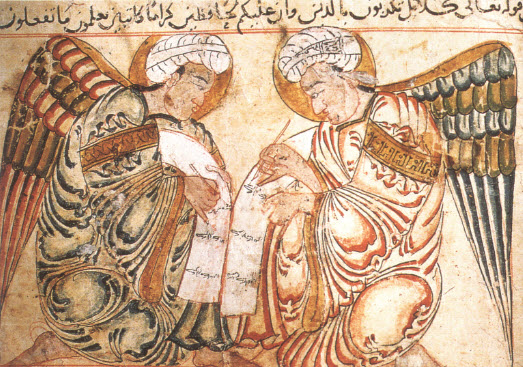
In the miniature from The Wonders of Creation, as companions and protectors of mankind, guardian angels have the special task of recording the works of humans in books and reciting their deeds on the Day of Judgement. The angels may then intercede for humanity asking God to be merciful.
Adapted from Islam – World Religion and Cultural Power, Markus Hattstein
Compiled by Nimira Dewji
 Ismailimail