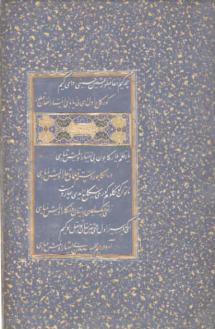
Due to the sacred nature of the Qur’an, copying the text, like its recitation, was a pious act. Hence, all the arts associated with the text – copying, conserving, and decorating – acquired increasing prestige. While calligraphy occupied one of the prime spots in the field of artisitic expressions, the decorative arts developed into a sophisticated art form. Geometric patterns, stylized flowers (arabesque), marks in the margins or in the punctuations, all allowed the artists to develop new styles, which first appeared in the Qur’an manuscripts, but were later used in secular books.
The illuminator began to acquire a prominent position alongside the calligrapher and the binder, producing manuscripts for the rulers and prominent figures until the nineteenth century. The art of leather, for bookbinding and for the producing inks (gold and colours), also witnessed innovations.
Princely workshops for the production of manuscripts and books were established in many regions. The book was associated with power; owning a library rich in scientific, philosophical, literary, and historical works was a symbol of the cultivated sovereign.
Libraries existed all over the Muslim regions with major ones at Qayrawan, Cordoba, Fez, and Fatimid Cairo; the Fatimid library was a wonder of the medieval Islamic world. The library at Baghdad was famous until the end of the thirteenth century – it was the centre of translation of Greek and Roman works, the composition of volumes on history, as well as secular and religious sciences and Arabic literature.
In the Iranian regions, the kitabkhana, or kutubkhana (“house of book,” or “of the books”) was both a library and a workshop for the copying of manuscripts. Around the sixteenth century, Persia took a lead in artistic styles thereby initiating a glorious period for Persian book crafts. New methods of book production and completely revolutionary techniques were introduced and these were to have a lasting impact on Islamic book production for centuries to come.
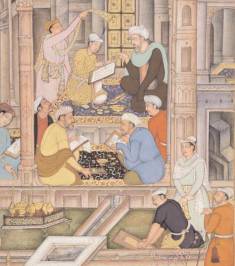
The precise organization of the workshop-library is described in texts of Mughal India in the late-sixteenth and seventeenth centuries. In several works such as the Akbar-nama and Akhlaq-i Nasir (Ethics of Nasir), the workshop-library is described as being located close to the imperial palace where calligraphers, bookbinders, illuminators, and book dealers were found. The rulers ordered copies of books, some for their own libraries and others for gifting.
The workshop, under the direction of the librarian (kitabdar) who was appointed by the sovereign, was responsible for acquiring books that suited the taste of the patron. In Mughal India, the librarian was also the guardian of the imperial library and therefore a man of great importance.
In the Ottoman empire, the workshops, naqqashkhana (or naqqashane, “house of the painters”) incorporated Persian and Mamluk traditions. The artists at these workshops, along with their illustrators, also created decorations for objects and buildings.
Before the advent of modern printing technology, the institution of the kitabkhana remained a lively production of artistic works admired by the learned and the sovereign.
Sources:
Francis Richard, “The Kitabkhana: An Institution in the Service of
Culture and the Art of the Book,” Treasures of the Aga Khan Museum: Arts of the Book & Calligraphy
Delicacy and Harmony in Persian Book Covers, The Institute of Ismaili Studies
Compiled by Nimira Dewji
 Ismailimail