Before the advent of Islam, Arabic was a spoken language among the various tribal kingdoms. Although these kingdoms had developed a sophisticated tradition of poetry, it was passed down orally. The first revelation to the Prophet was about knowledge and learning. The Qur’an also mentions writing materials and written books including the “well-preserved tablet” and the “celestial pen” and states that God “taught man by the pen.” The first verse of the chapter Sūrat al-qalam (“The pen”) is often understood as an expression to the exalted status of writing.
Hence, revelation became a catalyst in the widespread use of the Arabic language in written form. Calligraphy, the art of transcribing the Qur’an in beautiful scripts, developed into an esteemed art form and was considered an act of piety and devotion.
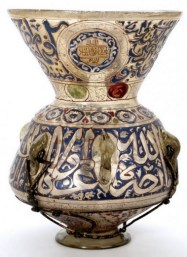
Although the art of writing on objects dates back to ancient times, in Islamic lands Qur’anic inscriptions, along with geometric patterns and arabesque, became the most distinctive form of decoration. Certain verses were often inscribed on specific objects such as the Ayat al-Nur (24:35) (The Verse of the Light) was inscribed on mosque lamps, while others such as Surat al-Baqara (2:144) were inscribed on textiles that covered the Ka’ba.
Some palaces and domestic settings also included religious inscriptions such as the al-Asma al-Husna (Beautiful Names of Allah) and specific verses on doors and gateways for protection. Items worn close to the body – jewellery and clothing – were often inscribed with prayers also for protection.
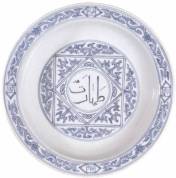
Inscriptions were also made on objects used in daily life such as bowls, vases, serving dishes, among others. The most common type of text inscribed on works of Islamic art comprises prayers and good wishes, which can range from a single word (the most common is baraka, blessing) to long phrases with rhyming pairs of nouns and adjectives.
The dish on the right, in the Aga Khan Museum’s collection, produced during the early sixteenth century, has Chinese calligraphy with the word Taharat, meaning purity. The rim is inscribed with the Prophetic Hadith Blessed is he who purifies his hand from wrongdoing. The inscription on the exterior of the dish says: Ablution upon ablution is light upon light, a Hadith traced back to Prophet Muhammad and the Shi’i Imam Jafar al-Sadiq.*
Sources:
*Fahmida Suleman, “Epigraphy and Inscriptions on Objects,” Treasures of the Aga Khan Museum – Arts of the Book & Calligraphy
Sheila Blair, Islamic Arts & Architecture (accessed December 2015)
The Khalili Collection (accessed December 2015)
Compiled by Nimira Dewji
 Ismailimail