The first House established for the people was that at Bakka (Mecca), a holy place and a guidance to all beings. Therein are clear signs – the Station of Abraham and whosoever enters it is in safety. It is the duty of all men towards God to make a pilgrimage to the House if they are able. (Qur’an 3:96-97)
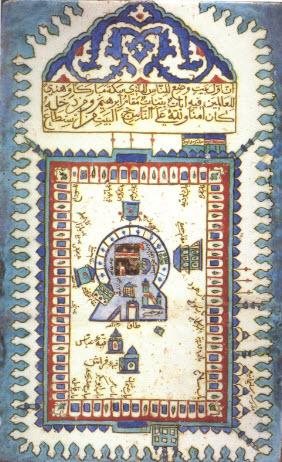
The Ka’ba, situated in Mecca, is the focal point of orientation (qibla) of the daily canonical prayers (salat) of Muslims, of the deceased buried in their graves, and of the Pilgrimage (hajj), which takes place during the first two weeks of the month of Dhu’l Hijjah. The minor hajj, or umra, may be undertaken at any other time. The Ka’ba and its nearby large mosque are referred to in the Qur’an as the House of God (bayt Allah) and the sacred mosque (masjid al haram).
In pre-Islamic Arabia, people from all over Arabia flocked to the Ka’ba once a year to worship the over 300 idols that it housed. In the year 629, Prophet Muhammad removed the idols from the Ka‘ba and restored it to its original role as the symbol of a monotheistic faith and affirmed it as the site of the hajj. He also linked the Ka‘ba to Prophet Ibrahim (Abraham), who, with his wife Hagar and son Ismail (Ishmael), is believed to have established a place of worship there upon God’s command.
Nearby, just east of the Ka‘ba, is the Well of Zamzam, which is also linked with the Abrahamic tradition in which the well sprang forth by God’s grace in response to the intense prayers of Hagar. Its water is made available to pilgrims through a modern system of pipes.
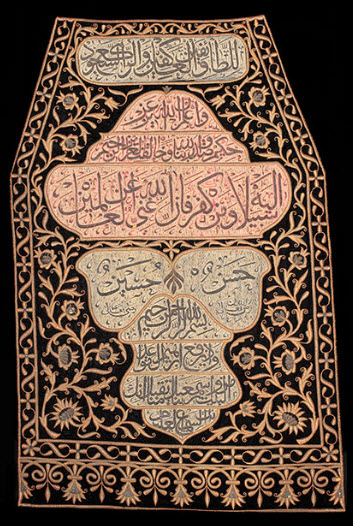
The four corners of the Ka’ba, an irregular cube, are generally aligned with the four points of the compass. A black silk cloth, the kiswa, embroidered with Qur’anic verses covers the Ka’ba and is replaced annually, a practice that originated during medieval Muslim history. The fabrics of the previous kiswa were traditionally distributed between the ruler of Mecca, the gatekeepers of the Ka’ba, and other prominent people of Mecca who cut the textiles into fragments and sold them to pilgrims as souvenirs of the hajj. Hence, a large number of fragments of these fabrics now exist in museums and private collections. The empty interior of the Ka’ba is customarily cleaned before the hajj.
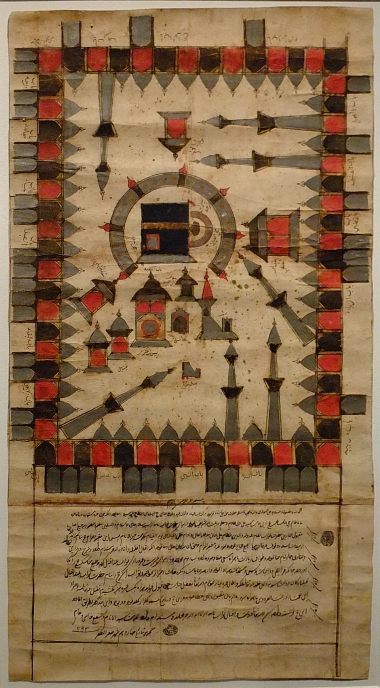
Pilgrims were often given an illustrated certificate to mark the completion of the pilgrimage. This certificate, dated 1778-79, in the Aga Khan Museum’s collection, depicts the Masjid al-Haram with the Ka’ba in the centre. The Persian text below indicates that the certificate belonged to Bibi Khanum who required the services of Sayyid Ali Wali to perform the hajj; Sayyid Ali guaranteed the performance of the hajj rites. Persian was the literary language of many Indian Muslims; some draftsmen may have been working ‘on site’ during the pilgrimage.*
References:
* Spirit & Life Catalogue, Masterpieces of Islamic Art from the Aga Khan Museum Collection, Published by the Aga Khan Trust for Culture
Azim Nanji, Ka’ba or Kaaba, Medieval Islamic Civilization, The Institute of Ismaili Studies (accessed September 2015)
Compiled by Nimira Dewji
 Ismailimail