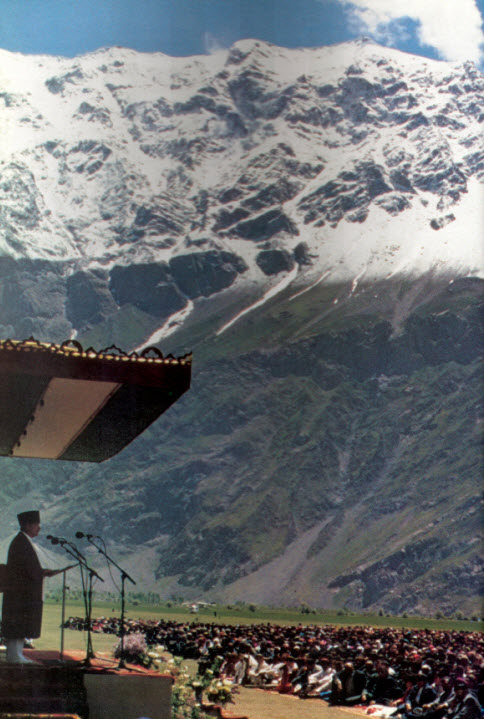
In 1995, in an unprecedented event in the recorded history of the Imamat, Mawlana Hazar Imam granted a mulaqat to the Jamat of the Central Asian tradition of our tariqah, first in Russia in January, and then in Tajikistan in May.
Historically, Central Asia comprised Afghanistan, Kazakhstan, Kyrgizstan, Northern Pakistan, Tajikistan, Uzbekistan, Xinjiang province of China, and north eastern Iran. As part of the Silk Road, the region has been diverse, pluralistic, and intellectually dynamic, producing some of the most prominent Muslim scholars including Ibn Sina, Al-Biruni, Firdousi, and Rudaki.
Ismaili da’is went to Central Asia from Fatimid Egypt to spread the da’wa (mission) during the reign of the Samanid Emir, Nasir II bin Samani (914-943). Subsequent ruling dynasties of the region persecuted the Ismailis and other Muslim communities for their differing beliefs and traditions. Consequently, many Ismailis migrated to the remote areas of Badakshan, where they practised their faith based on the teachings of da’i Nasir Khusraw, who had been appointed chief da’i by the Fatimid Caliph-Imam al-Mustansir (r.1036-1094). Nasir-i Khusraw faced enormous challenges in spreading the da’wa eventually living in exile in Yumgan, in modern day Afghan Badakshan, which was ruled by an Ismaili amir, Ali b. Asad. It was here, that Nasir-i Khusraw produced his major works and earned his reputation. He is regarded as the founder of the Ismaili spiritual and intellectual tradition of Central Asia.
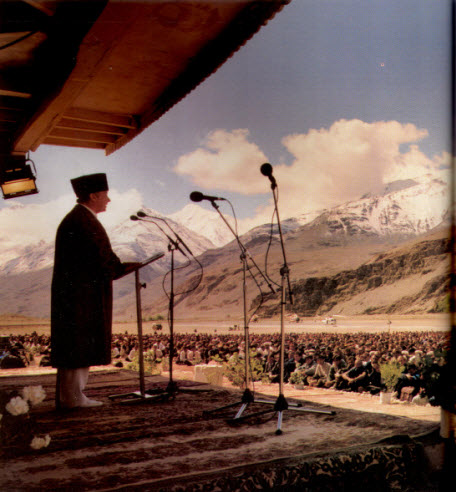
Colonial expansion by rival powers in the mid-nineteenth century further fragmented the region and isolated the Ismailis of Central Asia. The region became divided between China, Soviet Union, Afghanistan, and British India. As a result, those who came under Soviet rule lost physical contact with the Imam, but maintained their religious identity and traditions under the community’s local leadership, practising their faith in secrecy.
At the end of British colonial rule in the Indian subcontinent, the northern areas of Central Asia were incorporated into Pakistan. Mawlana Hazar Imam’s visit to Hunza in 1960 was the first mulaqat in the history of the Ismaili Imamat.
The dissolution of the Soviet Union into the Commonwealth of Independent States in 1991 enabled the Ismailis to establish physical contact with the Imam. In 1993, the activities of the Aga Khan Development Network (AKDN) in Tajikistan brought hope and improved the quality of life of all people in the region.
The visit to Moscow was organized in response to an invitation by the Russian Government. In Moscow, Mawlana Hazar Imam met with federal and local government officials, religious leaders, academicians, and the media. The various discussions focused on the Aga Khan Development Network’s (AKDN) programs in eastern Tajikistan for emergency humanitarian relief, as well as long-term developments in agricultural production, and the health and education systems. Mawlana Hazar Imam visited the Institute of Oriental Studies of the Russian Academy of Sciences, discussing the possible collaboration with The Institute of Ismaili Studies and the Aga Khan University.
In Tajikistan, Mawlana Hazar Imam discussed in his public address the creation of an Education Fund to support the training of English language and Economics; a long-term plan for the University of Khorog; regional transportation links for Tajikistan; the creation of a Badakshan Development Fund, an initiative of the Aga Khan Fund for Economic Development, to promote industry, mining, financial services and infrastructure.
Visiting Tajikistan and Kyrgyz Republic at the invitation of their governments, Mawlana Hazar Imam reviewed the projects of the AKDN that had begun in 1991 – these activities involved cultural revitalization and social development projects as well as the emergency humanitarian assistance that had been provided.
Mawlana Hazar Imam granted mulaqats, often in remote settings of spectacular beauty, in Moscow, Dushanbe, Khorog, Roshtkala, Murghab, Sijd, Ishkashim, Rushan, and Bishkek.


References:
Sarfaroz Niyozov, Evolution of the Shi‘a Ismaili Tradition in Central Asia, The Institute of Ismaili Studies
The Ismaili – International, May and July 1995
Compiled by Nimira Dewji
 Be the First to Know – Join Ismailimail
Get breaking news related to the Ismaili Imamat, the world wide Ismaili Muslim community and all their creativity, endeavors and successes.
Inspired? Share the story
Want to inspire? Send your stories to us at Ismailimail@gmail.com
Subscribe and join 23,000 + other individuals – Subscribe now!
Earlier & Related from the Ismailimail Archives
 Mawlana Hazar Imam was gifted manuscripts on architecture of Andalusia, a Knowledge Society of its time - The fundamental reason for the pre-eminence of Islamic civilisations lay neither in accidents of history…
 Mawlana Hazar Imam Designates Ismaili Center Houston as Darkhana for US Jamat, the ninth Darkhana - (the light is lit) in houses of worship which God has allowed to be raised,…
 Imam Hasan ala dhikrihi’l-salam appointed Sinan as his deputy in Syria - Rashid al-Din Sinan, the greatest of the medieval Nizari Ismaili da’is in Syria, was born into a…
 The arts of the Fatimids, Mawlana Hazar Imam’s ancestors, continue to inspire - The official logo for Hazar Imam’s visits comprises the word nur, Arabic for light, repeated…
 Rumi: “The light that lights the heart is the Light of God” - Didar – A Persian word meaning ‘seeing” or “vision.” The vision can be experienced both…
 Pir Sabzali: “Hearing the farman, their eyes brimmed over with tears of joy” - After the fall of the Nizari Ismaili state of Alamut to the Mongols in 1256,… Al-Tusi: “The ‘nass’ is not in order to make him an Imam; it is … so that people should recognise him as such” - “O Messenger, deliver [to the people] what has been revealed to you from your Lord,…
 Ismailimail
Great sharing. I am feeling blessed with the Nazar e Karam of Mowlana Hazir Imam.
LikeLike