“A central premise of our work is that cultural enrichment and historic restoration can also be effective springboards for economic and social progress.
We have been encouraged by the impact of this project on the lives of some 20,000 inhabitants of the Nizamuddin Basti area.”
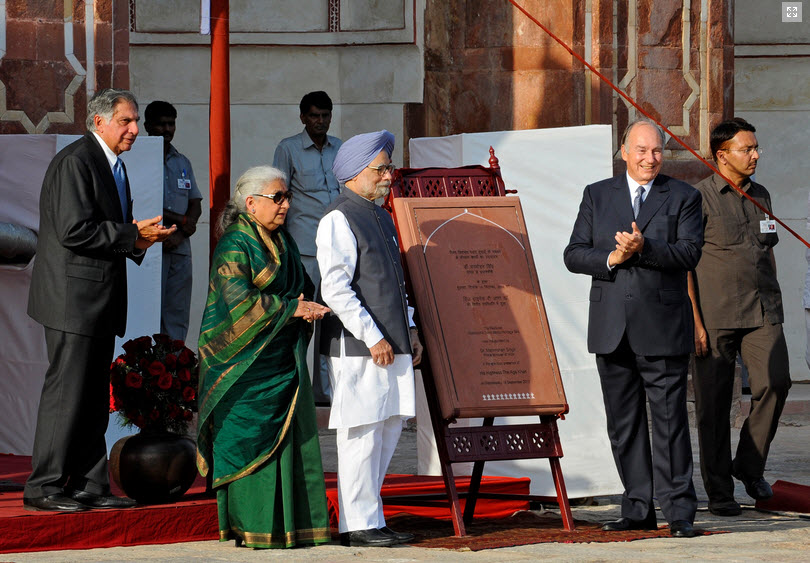
– His Highness Prince Karim Aga Khan at the inauguration ceremony of the restored Humayun’s Tomb and Garden, Delhi, India, September 18, 2013
An Indo-Muslim dynasty (r.1526 – 1858), the Mughals ruled over most of South Asia and parts of what is now Afghanistan. The Mughal Emperors accorded great importance to architecture as a symbol of kingship. When Akbar succeeded to the throne in 1556, his first major architectural project was the construction of his father’s (Humayun) tomb in Delhi. Humayun was the second Mughal Emperor and the son of Babur, who founded the Mughal dynasty.
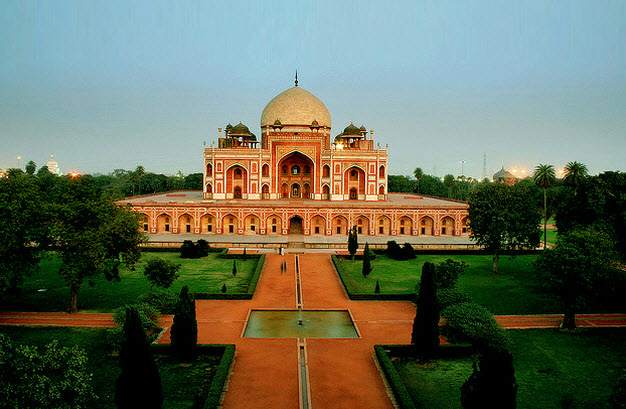 The tomb of Humayun, one of the twenty-seven UNESCO World Heritage Sites in India, was the first of the monumental mausoleums to be built in the country. Begun in 1562, the work on the tomb was completed in 1571. Placing the mausoleum in the centre of a large chahar bagh (Fourfold Garden) was an innovation in design of tombs and gardens, and was unique in the Indian Subcontinent. Humayun’s tomb, influenced by Persian architecture, with its domed chambers of monumental magnificence, came to characterize the splendour of the dynasty and was a model for later Mughal tombs such as the Taj Mahal. Built of rubble masonry, the structure is the earliest example of the use of red sandstone and white marble in such great quantities.
Humayun’s tomb was restored by the Aga Khan Trust for Culture (AKTC), in collaboration with the Archaeological Survey of India. Together with the conservation works on Humayun’s Tomb, a number of adjoining monuments have been restored, including: Nila Gumbad, Isa Khan’s garden tomb, Bu Halima’s garden tomb, Arab Serai gateways, Sundarawala Mahal and Burj, Batashewala group of Monuments, Chausath Khambha, and Hazrat Nizamuddin Baoli.
His Highness the Aga Khan presided over the inauguration ceremony of the restored Tomb and Garden on September 18, 2013. In his address, the Aga Khan stressed the importance of restoration work as vectors for economic progress:
“A central premise of our work is that cultural enrichment and historic restoration can also be effective springboards for economic and social progress. Rather than being a drain on fragile economies, as some once feared, investment in cultural legacies can be a powerful agent in improving the quality of human life. The impact of such projects can begin by diversifying local economies, expanding employment and teaching new skills. And a continuing stream of visitors, properly guided and welcomed, can provide income streams far into the future, which can be further invested in economic growth. We have been encouraged by the impact of this project on the lives of some 20,000 inhabitants of the Nizamuddin Basti area.” *
References:
* Speech, Aga Khan Development Network
Humayun’s Tomb Complex Restoration, Archnet
Urban Renewal in Delhi India, Aga Khan Trust for Culture
Research by Nimira Dewji
 Be the First to Know – Join Ismailimail
Get breaking news related to the Ismaili Imamat, the world wide Ismaili Muslim community and all their creativity, endeavors and successes.
Inspired? Share the story
Want to inspire? Send your stories to us at Ismailimail@gmail.com
Subscribe and join 20,000 + other individuals – Subscribe now!
Earlier & Related from the Ismailimail Archives
 Mawlana Hazar Imam was gifted manuscripts on architecture of Andalusia, a Knowledge Society of its time - The fundamental reason for the pre-eminence of Islamic civilisations lay neither in accidents of history…
 Mawlana Hazar Imam Designates Ismaili Center Houston as Darkhana for US Jamat, the ninth Darkhana - (the light is lit) in houses of worship which God has allowed to be raised,…
 Imam Hasan ala dhikrihi’l-salam appointed Sinan as his deputy in Syria - Rashid al-Din Sinan, the greatest of the medieval Nizari Ismaili da’is in Syria, was born into a…
 The arts of the Fatimids, Mawlana Hazar Imam’s ancestors, continue to inspire - The official logo for Hazar Imam’s visits comprises the word nur, Arabic for light, repeated…
 Rumi: “The light that lights the heart is the Light of God” - Didar – A Persian word meaning ‘seeing” or “vision.” The vision can be experienced both…
 Pir Sabzali: “Hearing the farman, their eyes brimmed over with tears of joy” - After the fall of the Nizari Ismaili state of Alamut to the Mongols in 1256,… Al-Tusi: “The ‘nass’ is not in order to make him an Imam; it is … so that people should recognise him as such” - “O Messenger, deliver [to the people] what has been revealed to you from your Lord,…
 Ismailimail