
The medicine of medieval Islamic civilization was built primarily on Greek medicine, particularly the writing of Hippocrates (460-375 BC), a physician who is considered one of the most outstanding figures in the history of medicine, and Galen (130 AD-200 AD), a prominent physician, surgeon and philosopher.
Greek knowledge was a trampoline for the vigorous scientific activity in Islamic civilizations. Islamic scientists and philosophers were engaged not only in preservation of the knowledge of the past, but also in advancing it, formulating new discoveries and making significant contributions to medicine and other fields.
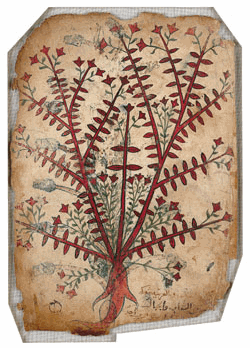
One of the earliest scientific manuscripts to be translated from Greek to Arabic was Dioscorides’s De Materia Medica (“On Medical Material”) as it is called in Latin. Pedanius Dioscorides (40 AD – 90 AD), a Greek physician who resided in Rome, wrote his treatise on medicinal plants in the first century. This treatise was a compendium of all the materia medica then known from Greek medicine and other sources, describing some 600 plants and their possible medical uses. The manuscript was translated into Arabic in Baghdad in the ninth century and became the foremost classical source of modern botanical terminology. The original Greek manuscript, which was copied in at least seven languages, served as the primary text of pharmacology until the end of the fifteenth century.
The folio here is from a rare dispersed thirteenth-century Arabic copy of the text, in which are depicted various medicinal herbs and roots. The page also shows a single-stemmed plant with red spiky blossoms, and the text states that this medicinal plant is used in the treatment of skin disorders including pustules, itching and ulcers.
References:
Pedanius Dioscorides, Encyclopaedia Britannica
Aga Khan Museum Online Gallery
Research by Nimira Dewji
Related:
- Mawlana Hazar Imam was gifted manuscripts on architecture of Andalusia, a Knowledge Society of its time
- Mawlana Hazar Imam Designates Ismaili Center Houston as Darkhana for US Jamat, the ninth Darkhana
- Imam Hasan ala dhikrihi’l-salam appointed Sinan as his deputy in Syria
- The arts of the Fatimids, Mawlana Hazar Imam’s ancestors, continue to inspire
- Rumi: “The light that lights the heart is the Light of God”
- Pir Sabzali: “Hearing the farman, their eyes brimmed over with tears of joy”
- Al-Tusi: “The ‘nass’ is not in order to make him an Imam; it is … so that people should recognise him as such”
- Mawlana Hazar Imam Aga Khan V: “The Shia Ismaili Muslim community, of which I am the Imam, has been established in Syria for more than 1,000 years”
- Mughal Emperor Akbar’s pluralism is evidenced by an inscription of Hazrat Isa’s teaching on his “Victory Gate”
- Moment in Time | 1 January 1931 – Ivanow, the pioneer of Ismaili Studies, began to work for Sir Sultan Muhammad Shah Aga Khan III
 Ismailimail