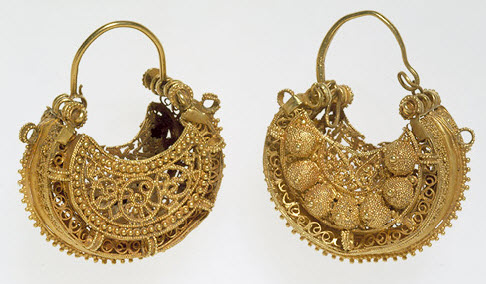
Elaborate example of filigree and granulation work from the Fatimid period.
Pair of earrings dated 11th century Fatimid period. Image: The Metropolitan Museum of Art
This pair of earrings is illustrative both of the most characteristic goldsmith work and of one of the most popular shapes for jewelry of this period – the hilal, or crescent (moon).
The basic vocabulary – a box construction, rings for stringing pearls or semiprecious stones, openwork S-curves, arabesque designs, and the crescent shape itself – seems to have dominated jewelry production in the Fatimid world into the second half of the eleventh century and perhaps later.
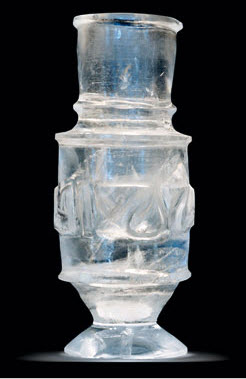
Rock crystal bottle in the Aga Khan Museum’s collection has a kufic script inscription in Arabic which translates as ‘Glory and prosperity to its owner.’
The Fatimid Caliphate was officially established in North Africa when Imam al-Mahdi was proclaimed caliph in 909 in Tunisia, North Africa. In 973, Imam al-Mu’izz transferred the capital of the Fatimid Empire to Cairo, a city founded by the Imam who also laid the foundation of the Al-Azhar mosque.
During the Fatimid period, the Ismailis developed a diversity of intellectual traditions and institutions, making important contributions to Islamic thought and culture. The Fatimid period was also a golden age of arts and crafts, and Cairo became a major centre for the production of valuable artefacts. Furniture and textiles made in Cairo had a particularly high reputation and were exported to the entire Mediterranean area. Many Fatimid textiles, cherished by pilgrims, made their way to Western churches. Trade between the Muslim world and Europe developed as a result of the geographic proximity of these regions as well as improvements in navigation.
Ceramics were much sought after in Italy, where Fatimid bowls – bacini – were used as decorative items or as vessels for religious ceremonies in churches built in the eleventh to the thirteenth centuries. Items made of wood, ivory, and rock crystal were amongst the most attractive artefacts of the Fatimid period; they were widely sold as luxury goods. According to the historian al-Maqrizi (d. 1442), approximately 18,000 items of rock crystal and glassware were taken to Europe. The pure quality of the quartz crystal used to carve the artefacts made them suitable gifts for guests of high rank.
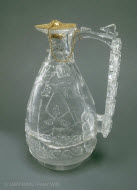
Ewer at the Louvre, Paris
Fatimid rock crystal objects are found today in European royal and church treasuries. An extraordinary ewer is kept in the Astorga cathedral museum in Spain; another, in the San Marco church treasury, Venice, features an inscription with the name of the Fatimid Imam-Caliph Mawlana al- ‘Aziz (r. 975-96).
“The treasury of the Abbey of Saint-Denis included several hardstone vases with elaborate mounts. Among them was this rock crystal ewer, made in a Fatimid workshop with the later addition of a filigree gold lid made in Italy.
This ewer demonstrates the artistry of rock crystal carvers in 10th- and 11th-century Cairo and gives some idea of the splendor of the abbey’s treasury.”
 Be the First to Know – Join Ismailimail


![[Music in Islam] Is listening to music unlawful?](https://ismailimail.fun/wp-content/uploads/2014/08/music-in-islam.jpg?w=150)
 Ismailimail