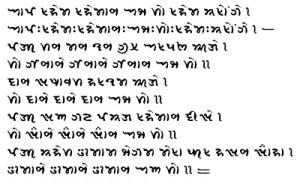
 As mentioned in “The Imminent Paradox of New Scripts in Unicode”, I have begun to develop Graphite fonts for several of the historical and minor scripts that I have proposed for inclusion in the Unicode Standard. The first of these fonts is for Khojki, which I proposed for encoding in Unicode a few years ago and will likely appear in The Unicode Standard, version 7.0, planned for release in 2014.
Khojki is a medieval Indic script from the Sindh region of modern Pakistan, which is used for liturgical purposes by the Nizari Ismaili community, and which has been preserved by this minority community for six centuries, both at home and in their diaspora. The script has been used since the 15th century for manuscripts and since the early 20th century for the printing of books. There are organizations, such as the Institute of Ismaili Studies (IIS) in London, which possesses a large collection of materials in Khojki, and several scholars worldwide that conduct research on these materials, that will benefit from this effort.
via Anshuman Pandey: A Graphite Font for Khojki.
Earlier related: A new proposal to encode Khojki in Unicode

 Ismailimail