Robert Remington,
Calgary Herald
Friday, May 09, 2008
  View Larger Image View Larger Image |
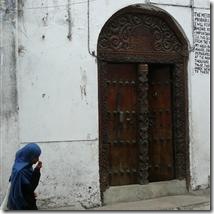
A woman in traditional dress walks past a carved wooden door in Stone Town, a UNESCO World Heritage site on the island of Zanzibar. Twenty years ago there were about 800 carved doors in Stone Town, but that number has dropped significantly. The oldest door discovered in Zanzibar is dated 1694.Robert Remington, The Calgary Herald |
It was certainly effective, but not the best thing for employee morale. So impressed was he by the intricate wooden door the Indian carver had made for his palace that the ruling sultan promptly ordered the poor fellow’s hands be lopped off.
Thus, the sultan prevented the carver from replicating his work of art and was able to lay claim to having the grandest door in all of Zanzibar.
Whether the legend is true could not be confirmed. But Moses, our affable guide, said it was so. It seems like the kind of thing that might happen in a slave trading colony where up to 50 African men and women at a time were packed into small subterranean cells before being tied to a whipping post in the town square and flogged prior to being auctioned off.
To cry out was a sign of weakness, which meant a low price and banishment to the lower rungs of slave society, provided you survived the whipping. A society that valued human life so little was certainly capable of sawing off a hand or two.
Today, a church stands on the site of the old slave market in Stone Town, the historic capital of this exotic island in the Indian Ocean. The whipping post still survives behind the altar as a reminder of the island’s grim past, and beneath the church it is possible to make your way into the underground slave holding cells, where the only fresh air came from two small slits in the walls.
About 50,000 African slaves passed through Stone Town each year, part of the estimated 11 to 18 million black African slaves that were sent to the Byzantine Empire and Muslim world from 650 to 1900 – a worse record than the 9.4 to 14 million Africans brought to the Americas in the Atlantic slave trade.
Through the doors of Zanzibar
As with most grand or public buildings in Stone Town, visitors enter the church through a large, carved wooden door, similar to the one that cost the Indian carver his hands.
These remarkable carved doors, each an individual work of art, are a symbol of Stone Town, a UNESCO World Heritage Site known for its narrow, labyrinthine alleyways, white sand beaches and intoxicating blend of Arabic and African culture.
The town, with buildings built of coral stone and lime, is on the brink of decay. Many of its beautiful doors are weathered and rotting, too.
The little money that exists for restoration comes from outside donors and organizations like the Aga Khan Trust for Culture, which is spending $2.2 million on a major restoration project in the heart of Stone Town.

 Ismailimail
Although Yasmin Alibhai-Brown quoted – to paraphrase -the slave trade in Zanzibar as “the dark side” of this lovely little island – we all know that Zanzibar was not the only island utilised for slave trade. Many other parts of Africa were involved in the slave trade – something that is absolutely horrible and today, unimaginable. It is gut-wrenching to think of what these poor souls went through, for no fault of their own. ROOTS, the miniseries depicts some of that.
But like elsewhere in the world, times have changed, for the better. Zanzibar has been through a lot and has tried to stabilize since. It is indeed paradise on earth and the restoration of Forodhani Park further attests to the fact that the future holds better things for Zanzibar, the heartbeat of Africa.
LikeLike