“The Muslim world has tremendous diversity,” says Babul, who is a member of the Ismaili community.
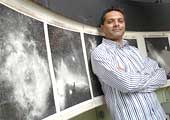
By Valerie Shore
Dr. Arif Babul remembers the exact moment when his lifelong passion for outer space began. It was July 20, 1969, and he was one of millions around the world who were glued to their televisions as Apollo 11 astronaut Neil Armstrong stepped down onto the moon and into history.
“I was completely captivated by the whole idea of space and trying to understand the universe,” says Babul, who was six years old at the time. That moment launched him on an intellectual path that, 38 years later, has led to his new title as a University of Victoria Distinguished Professor.
The title is the highest academic honour that the university can bestow on a faculty member. It is awarded to individuals who have achieved great distinction in teaching and research, and who have made a substantial contribution to the university and the wider community.
“Arif is an internationally acclaimed scientist, a dedicated teacher at all levels, and a strong promoter of broad intellectual discourse within and outside the university community,” says Jamie Cassels, vice-president academic and provost. “He is a wonderful university citizen and his achievements and contributions make him highly deserving of this award.”
Babul is a specialist in theoretical cosmology who studies the origins of structure in the universe and the evolution of galaxies. He develops theories of how the universe evolved, and tests them with computer-based numerical simulations.
His quest is to understand how the universe evolved from an extremely smooth state at the time of the “Big Bang” 13.7 billion years ago, into the rich tapestry of dark matter and galaxies that we see today.
“Since the beginning of human civilization we have been wondering how the universe came into being, how life evolved, how it all came together,” he says. “It’s a fascinating riddle.”
Born in Tanzania, Babul emigrated with his family to Canada in 1973 due to political instabilities in East Africa at the time. “My parents were doing really well there, at least materially,” notes Babul. “In moving to a new country, they made tremendous sacrifices to secure a brighter future for us, the next generation.”
Encouraged by “phenomenal” high school teachers in Toronto, Babul’s aptitude for science and mathematics flourished. He later earned a BASc in engineering science from the University of Toronto and a PhD in astrophysical sciences from Princeton University. After three years at New York University he joined UVic’s Department of Physics and Astronomy in 1997.
“I spent a month here before I decided to take the job,” recalls Babul. “I found a tremendously vibrant group ranked as the top in Canada and one of the best in North America. It was, and still is, a very stimulating environment to be in.”
Although Babul is barely in mid-career, he already has an international reputation for quality research. Three-quarters of his papers rank within the top 10 per cent in terms of citations—a clear measure of the impact he is having in his field.
Babul is also founding director of the UVic-based Canadian Computational Cosmology Collaboration (C4), in which computational cosmologists from coast-to-coast are using massive computer-generated simulations to trace the evolution of the universe.
In 2002, Babul was awarded a senior fellowship from the Canadian Institute for Theoretical Physics and in 2006, he received the prestigious Leverhulme Visiting Professorship that he held jointly at the University of Oxford and Durham University in England.
At UVic, Babul was the 2004 winner of the Faculty of Science Award for Research Excellence and is a highly regarded mentor and teacher. He is especially well known for creating and teaching a popular third-year course for non-science students on the origin of space, time and matter in the universe.
“This is a must-take course for non-physicists,” wrote one student. “Dr. Babul has a gifted ability to explain mind-boggling concepts at a level that is easily understood, even though it feels like you leave each class with a mental hangover.”
Babul’s intellectual pursuits also extend to more earthly issues. Before and since 9/11, he has promoted public discussion on the nature, history and diversity of the Islamic civilization.
“The Muslim world has tremendous diversity,” says Babul, who is a member of the Ismaili community. “We speak hundreds of languages, come from many cultural backgrounds, and encompass a multitude of interpretations of faith. The vast majority are your average common folks just trying to live a decent life. It’s important for people in the West to understand that.”
In fact, in addition to his parents, teachers and colleagues, Babul credits the spiritual leader of the Ismaili community, the Aga Khan, for inspiring him to attain his childhood dream.
“As far back as I remember, the Aga Khan has always emphasized the pursuit of excellence in education and the intellectual legacy that Ismailis are heir to,” he says. “This message was central in driving me forward.”
“The Aga Khan has always promoted the value of education and has been monumental in my continuing to pursue excellence at the highest level,” he says.
Distinguished professors hold their title as long as they remain on faculty at UVic and continue to display excellence in their teaching, research and service. The award provides a five-year salary stipend and an annual professional development allowance.
Babul is the university’s 10th Distinguished Professor and the first from the Faculty of Science. For a complete list of winners, visit web.uvic.ca/vpac/news/professorawards.htm.

 Ismailimail
Amazing! Clearly a recognition well deserved! I really appreciated the article’s delve into what Dr. Babul is about, what motivates him and makes him tick. Dr. Babul seems to be an exceptional ambassador for UVic, but also for Muslims at large! All while he is still in his thirties!
LikeLike
I wish Dr. Babul would visit USA and deliver some of his inspirational work, in the form of seminar or talk to the Ismaili youth to inspire them and introduce the field of astrophysics that seems to be not well-understood by many. Bravo Dr. Babul !!
LikeLike
Excellent! very happy to know this news.I agree wit Mr.Karim Nooruddin that Mr.Babul has done wonderful job,pride for ismaili muslim community.He should now deliver some inspirational talks/seminars not only in USA,but places of high ismaili populations, to stimulate youth to reach to their full potential.
congrates for this award
LikeLike
An excellent achievement in the field of astrophysics and cosmology. It would be interesting to see if and how Dr. Babul would link his science to his religion. On this subject Mowlana Hazar Imam, in his many speeches, makes a clear connection between science and religion:
Education has been important to my family for a long time. My forefathers founded al-Azhar University in Cairo some 1000 years ago, at the time of the Fatimid Caliphate in Egypt. Discovery of knowledge was seen by those founders as an embodiment of religious faith, and faith as reinforced by knowledge of workings of the Creator’s physical world(Aga Khan IV, Cambridge, Massachusets, U.S.A., 1994)
In this context, would it not also be relevant to consider how, above all, it has been the Qur’anic notion of the universe as an expression of Allah’s will and creation that has inspired, in diverse Muslim communities, generations of artists, scientists and philosophers? Scientific pursuits, philosophic inquiry and artistic endeavour are all seen as the response of the faithful to the recurring call of the Qur’an to ponder the creation as a way to understand Allah’s benevolent majesty. As Sura al-Baqara proclaims: ‘Wherever you turn, there is the face of Allah'(Aga Khan IV, London, U.K., 2003)
The truth, as the famous Islamic scholars repeatedly told their students, is that the spirit of disciplined, objective enquiry is the property of no single culture, but of all humanity. To quote the great physician and philosopher, Ibn Sina: “My profession is to be forever journeying, to travel about the universe so that I may know all its conditions.”(Aga Khan IV, Karachi, Pakistan, 1983)
easynash(on Facebook as Easy Nash)
LikeLike
Dr. Babul is truly an inspirational role model to the youth of our community and to all of the Muslim ummah.
He should do seminars in US and all around the world where Muslims reside to make them aware that Ibn Sinha and Al Zahrawi are still among us to make the history.
LikeLike
6. Dr Alnoor Chagpar
Congratulations! way to go Arif. I agree with Zehra and others about doing inspirational talks internationally. Easynash, it is interesting that you quote Ibn Sina, ” My profession is…..’ Dr Babul uses that all the time if I remember correctly. Also in this public forum, I would like to wish ‘Shukhar” to Dr Babul whose father (a personal friend of mine) passed away recently-May Mawla rest his soul in eternal peace Amen. Arif, I am not sure that you know this your dad told me that Hazar Imam placed HIS hand on your shoulder during HIS visit to Mwanza, I thought you should know this- you are indeed blessed!
LikeLike