Published on August 22, 2007, 12:00 am
By Samuel Otieno and Samson Ntale in Kampala
The three East African states will soon have a power sharing pool to ease shortages.
Ugandan President, Mr Yoweri Museveni, said the strategy is to build grid interconnections to enable power flow from places of abundance to power deficit areas.
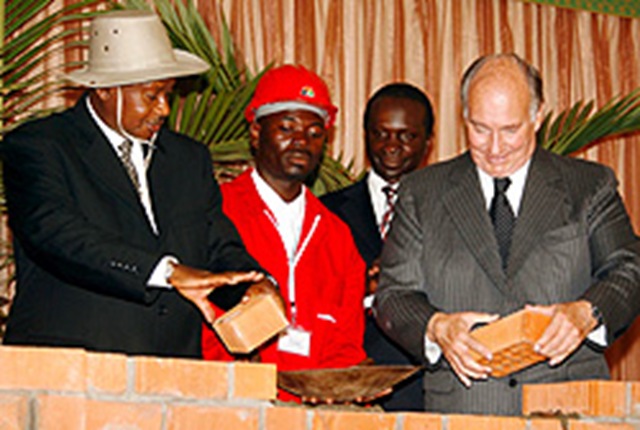 The Aga Khan (right) and President Yoweri Museveni of Uganda (left) at Bujagali Hydropower project, 90Km east of Kampala in Mukono District. The power plant will provide 250 mega watts. Picture by George Mulala The Aga Khan (right) and President Yoweri Museveni of Uganda (left) at Bujagali Hydropower project, 90Km east of Kampala in Mukono District. The power plant will provide 250 mega watts. Picture by George Mulala |
“Over a short period of time, we are going to link with other three East African Community countries to form the pool which will enable the countries to serve each other incase of power deficit,” said Museveni.
He was speaking in Jinja on Tuesday during the laying of the foundation stone for the Bujagali Hydropower project, which was also part of the 50th anniversary of His Highness, the Aga Khan, the spiritual leader of the Ismaili Muslim Community.
The East African Power Pool project is expected to be operational by 2011 once the required infrastructure is in place. Plans are also underway to incorporate Rwanda, Burundi and the DR Congo, Museveni said.
Aga Khan regretted Africa’s failure to exploit its hydropower potential
Currently, Uganda imports up to 20 MW of power from Kenya following the drop of water levels at the River Nile.
The drop has led to a severe 12-hour electricity load-shedding daily in Uganda, resulting in a slow down in economic growth.
The Aga Khan said the problem extends well beyond Uganda, noting that Africa produces only four per cent of the world’s electricity. Bujagali is being constructed by Italian firm, Salini.
“It has been difficult to inject huge private investment capital in Africa. This a milestone that will ensure shortages of dependable power is history East Africa,” the Aga Khan said.
He regretted Africa’s failure to exploit its hydropower potential. Africa’s is a sixth of the of the world population, but generates only four per cent of the world energy, much of which is produced in North and South Africa.
“The great issue of development, everywhere in the world, is whether the power supply will grow more quickly than the economy, or whether the economic growth will outstrip the power supply,” he said.
Largest single infrastructure investment
Museveni said the project is the largest single infrastructure investment of the Aga Khan Development Network worldwide.
An analyst and a co-author of various studies on the impact of energy loss in Uganda, Mr Lukule said: “Bujagali is critical to our long-term economic plans. After it, plans to develop more power projects must be expedited”.
The project will be completed within 44-months, with the first 50MW unit to be fed in the national grid within 36 months, said Dr Kevin Karuiki of Investment Promotion Services.
It is financed by the International Finance Corporation ($130million), European Investment Bank Euros ($100 million, Africa Development Bank ($110million), and commercial banks Barclays and Standard Chartered jointly extending loans amounting to $115 million.
“Premised on Build, Own, and Transfer (BOT) principle, the Bujagali power project is based on a 30 year Power Purchase Agreement with Uganda Electricity Transmission Company,” Karuiki said.

 Ismailimail