Ismailis worldwide Marking the Aga Khan’s Golden Jubilee
Over the years, the Aga Khan has received numerous decorations, honorary degrees, and awards in recognition of the various dimensions of his work
PART ONE OF A FOUR PART SPECIAL REPORT
Coastweek – – His Highness the Aga Khan became Imam (spiritual leader) of the Shia Imami Ismaili Muslims on July 11, 1957 at the age of 20, succeeding his grandfather, Sir Sultan Mahomed Shah Aga Khan.
He is the 49th hereditary Imam of the Shia Imami Ismaili Muslims and a direct descendant of the Prophet Muhammad (peace be upon him) through his cousin and son-in-law, Ali, the first Imam, and his wife Fatima, the Prophet’s daughter.
July 11 marks the start of a year long commemoration of the Aga Khan’s Golden Jubilee celebrations by Ismailis worldwide.
In the second half of the 19th and early 20th centuries, Ismailis from the Indian sub-continent migrated to East Africa.
Today, they live in some twenty five countries, mainly in West and Central Asia, Africa and the Middle East, as well as in North America and Western Europe.
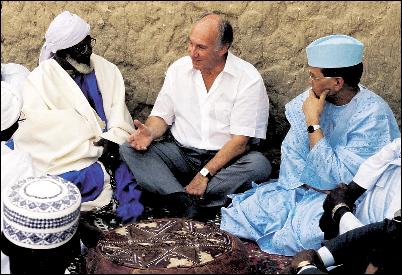
Coastweek – – His Highness the Aga Khan [centre] at
the 14th century Djingereiber Mosque, Timbuktu, with
the Imam of the Mosque and local dignitaries.
Over the five decades since the Aga Khan became Imam, there have been major political and economic changes in most of these areas.
He has adapted the complex system of administering the Ismaili Community, pioneered by his grandfather during the colonial era, to a new world of nation-states, which even recently has grown in size and complexity following the newly acquired independence of the Central Asian Republics of the former Soviet Union.
In consonance with the ethical underpinnings of Islam to be of service to humanity and support the needy and the vulnerable, wherever Ismailis live, they have elaborated a well-defined institutional framework to carry out social, economic and cultural activities.
Under the Aga Khan’s leadership, this framework has expanded and evolved into the Aga Khan Development Network (AKDN), a group of institutions working to improve living conditions and opportunities in specific regions of the developing world.
While each agency pursues its own mandate, all of them work together within the overarching framework of the Network so that their different pursuits can interact and reinforce one another.
Their common goal is to help the poor achieve a level of self-reliance where they are able to plan their own livelihoods and help those even more needy than themselves.
AKDN institutions work in close partnership with the world’s major national and international aid and development agencies.
The AKDN itself is an independent self-governing system of agencies, institutions, and programmes under the leadership of the Ismaili Imamat.
Their main source of support is the Ismaili community with its tradition of philanthropy, voluntary service and self-reliance, and the leadership and material under writing of the hereditary Imam and Imamat resources.
Over the years, the Aga Khan has received numerous decorations, honorary degrees, and awards in recognition of the various dimensions of his work.
Often described as a bridge between Islam and the West and a philanthropist, in Kenya, he is most commonly associated with the hospitals and schools that bear his name.
Source: Part I
Aga Khan Foundation’s (AKF) Coastal Rural Support Programme is another example of how A.K.D.N. supports LOCAL communities
PART TWO OF A FOUR PART SPECIAL REPORT
Coastweek – – Besides the Aga Khan Schools and the Aga Khan Hospitals found across East Africa, however, the Aga Khan has also expanded the scope of the Ismaili Imamat’s activity to include architecture, culture, microfinance, disaster reduction, rural development, the promotion of private-sector enterprise and the revitalisation of historic cities.
Other well-known Kenyan enterprises such as Diamond Trust Bank, Jubilee Insurance, Serena Hotels, Nation Media Group and Industrial Promotion Services all form part of the Aga Khan Fund for Economic Development (AKFED), the “for-profit” segment of the Network that funds the development work of the other agencies.

As the Aga Khan explains:
“[Our] criteria are far different from those of a straightforward commercial investor…
“For us, responding appropriately to economic opportunity means finding ways of positively impacting people’s lives. AKFED does seek to generate profits, but they are entirely reinvested in future development initiatives…
“All AKFED strategic investments are made in close consultation with the government…
“We seek ways to transfer knowledge and technical capacity to local citizens and to the national economy to generate an economic ripple effect.
“AKFED is ready to take justified investment risks — to a greater extent than many other investors.
“We are ready to be patient investors, with a far-ranging vision. We are long-term players, maintaining our presence even during periods of economic or political turbulence.”
Just five years ago, the inauguration of the Kipevu 11 Power Plant of the Tsavo Power Company (TPC), one of the largest diesel power plants in sub-Saharan Africa, launched the leading single overseas investment in Kenya at the time.
It increased Kenya’s power supply by 31 per cent.
It was also the first project constructed to meet the criteria of new environmental laws, with TPC also establishing a twenty year Environmental and Social Projects Fund with an annual budget of US$ 50,000.
Among the institutions that have been awarded grants are:
the Bombolulu Centre for the Physically Handicapped;
the Ziwani School for the Deaf;
the Likoni School for the Blind; Likoni Orphanage;
Kenya Sickle Cell Foundation;
Young Women’s Christian Association;
the Little Sisters of the Poor; Noor Islamic Orphanage;
Kwale District Eye Centre and many others.
TPC’s Community Health Programme also sponsored six Health Action days, and in conjunction with the Aga Khan Health Services and the Ministry of Health, provided health care assistance to over 26,000 people in the coastal and interior rural areas of Kenya.
The Aga Khan Foundation’s (AKF) Coastal Rural Support Programme is another example of how AKDN supports communities at the Coast.
Using a community-driven approach first tested in the early 1980s in AKDN’s work with rural communities in northern Pakistan.
The overall goal has been to create real improvements in livelihood amongst marginalised communities, and at the same time demonstrate that community-driven rural development is a long term, viable solution across the entire Coast Province.
Source Part II
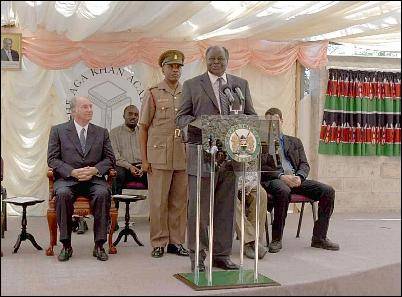
Latest addition to the Aga Khan Schools in Mombasa is the Aga Khan Academy, Mombasa
PART THREE OF A FOUR PART SPECIAL REPORT
Coastweek – – After surveys identified the poorest regions of Kenya, AKF went to work in 1997 and now serves 130,000 people in Kwale and Kilifi.
To date, the programme has supported the construction of dams, small farm reservoirs and water pipelines from which 40,000 villagers benefit both from increased water supply as well as the food security that comes with it.
AKF has trained villagers in community planning and has developed village development organisations that help coordinate community development and income generating initiatives.
In the process, AKF has established community savings groups that have accumulated over US$ 100,000 in savings. Additionally, AKF has helped establish early childhood development centres and trained teachers from the community that now teach 2,400 children.
Pre-school education has long been an area of focus for the Network, with the first Aga Khan Nursery School in Kenya opened in Mombasa almost seventy years ago.
In the mid-1980s, Muslim leaders from the Coast requested assistance in improving the overall educational standings of their youth.
AKF responded by initiating studies that revealed the problem stemmed from inadequate preparation for primary school.
The Foundation’s suggestion that appropriate early childhood education might be the key was well received by community leaders, and although resources were scarce, physical facilities were available in traditional madrasas.
Using an innovative programme that integrated traditional religious and cultural teaching, as well as by preparing children to meet primary school entrance requirements, AKF helped communities and parents develop the skills needed, supported by three Madrasa Resource Centres that AKF established for them.
The programme was so successful it quickly expanded to Zanzibar and Uganda.
Just last month, education officials from India came to review the programme, and other African countries are also involved in replicating it.
To date, across East Africa, over 200 madrasa schools are part of the programme and 4,500 teachers and parents have been trained, impacting 54,000 students, over 10 per cent of whom are non-Muslim.
Indeed, some madrasas at the Coast have more non-Muslims than Muslims enrolled.
The results have been dramatic; from children who had trouble in primary school, follow up studies have shown that madrasa pupils ranked among the top pupils in Standard 1 and generally in the upper 20 per cent through to Standard 4.
What’s even more impressive, the madrasa pre-schools are sustained without need of on-going donor supports, proving that communities can be trained to deliver quality education to their own children, even in low-income settings.
The latest addition to the Aga Khan Schools in Mombasa is the Aga Khan Academy, Mombasa, selected as the first site of a worldwide, non-denominational network of over 20 similar residential schools educating to the highest international standards.
Source: Part III
“Our goal, then, is not to provide special education for a privileged elite – but to provide an exceptional education for the truly exceptional”
PART FOUR OF A FOUR PART SPECIAL REPORT
Coastweek – – Over the next decade, additional Aga Khan Academies, or Centres of Excellence as they are also called, are planned for Tanzania, Uganda, the Democratic Republic of Congo, Madagascar, Mali, India, Pakistan, Bangladesh, Afghanistan, Tajikistan, Kyrgyzstan and Syria.
What is often not known is that admission is solely based on merit, not financial ability to pay fees.
In fact, students will be actively recruited.
In explaining the vision behind these new Academies, His Highness stated that:
“We are designing for the long-range future and we have thought long and hard about our goals and how to achieve them…
“At the very heart of our conclusions is one, central conviction: the key to future progress in the developing world will be its ability to identify, to develop, and to retain expert and effective home-grown leadership…
“Our goal, then, is not to provide special education for a privileged elite – but to provide an exceptional education for the truly exceptional.
“This is the fundamental philosophy undergirding our Academies programme.”
When it comes to health care, the AKDN has long been developing facilities for all peoples.
The Aga Khan Hospital grew from a simple maternity home established in Mombasa in 1945, and in 1980 became the first hospital to have an Intensive Care Unit in Mombasa.
However, behind the scenes, the Aga Khan Health Services (AKHS) and AKF have been working with the poor and rural communities at the Coast for almost twenty years.
In 1988 they launched the Mombasa District Health Care project and have also been supporting the Ministry of Health all along the Coast.
In 2000, AKF and the Community Health Department of AKHS initiated the development of a computerised Health Management Information System (HMIS) for the Ministry of Health in Kwale District of Coast Province.
The project was so successful, that over the next seven years, HMIS spread across all of Coast, North Eastern and Nyanza Provinces.
The system is now being expanded across all of Kenya, to over 7,000 facilities.
While Ismailis worldwide begin a year long celebration of fifty years of leadership by the Aga Khan, the rest of us who may have benefited from the work of the Aga Khan or the AKDN can also acknowledge his contribution towards the betterment of humanity.
As recognised by the German Minister of Foreign Affairs, Dr. Frank-Walter Steinmeier, during his address at the award ceremony honouring the Aga Khan with the Tolerance Award in Tutzing, Germany last year:
“We honour an exceptional man, we honour a huge friend of humankind, we honour a courageous visionary and we honour a person building bridges between societies … [who is a] fortress for democratic progress …
“A man who shows us a face of Islam that many of us do not know and sadly all too often we do not want to know: an Islam that is open, tolerant and willing to engage in dialogue.
“An Islam that is not in conflict with free, democratic and pluralistic societies.”
Source: Part IV

 Ismailimail